Zoe Saldana stars this action filled movie entitled Colombiana as Cataleya Restrepo whose parents were killed by Don Luis a drug lord.
At her young age, Cataleya witnessed how her parents got killed by Don Luis' team and left as the only survivor. In the midst of the chaos, as the young Cataleya , she manages to survive and flees to Chicago to meet up with her uncle.
Little detail is given about what information her father gave to his boss, and what exactly is Don Louis’ profession except for a few soft mentions of the exchange of drugs is all that is revealed. The purpose is that her parents are dead and now she wants to become an assassin. Essentially, we jump from young Cataleya to wanting to become a killer, since she wanted to take revenge on the death of her parents.
Cataleya grew up being an assassin, killing everyone who is connected to the person who killed her parents, and she also then works for her uncle Emilio, she remains focused on her ultimate goal: to hunt down and get revenge on the mobster responsible for her parents’ deaths.
The movie was pretty awesome and I admire how Zoe Saldana portrayed her character since I'm always fascinated by actresses who portrays a badass character, the only thing I didnt like on this movie was its ending. My reaction was "Really? That's how the story ends?" It was like a blink of an eye then the movie ends.
Is a film that revolves on the story of Ally Darling (Anna Faris) a young woman on her early thirties who is in search of looking for her right guy after she's been through alot of heart breaks.
One day, she then reads an article from a magazine with a title "What's your Number?". The article explains that a woman who have more than 20 sexual partner ends up growing up old. Threatened that this might happen to her, Ally started to make a list and track down the number of guys she made sex with.
As she checks on this list, it says that she already made 19 sex with different guys which means she only got one more sex then she'll hit the end of the thread.
Unfortunately, while she was on her sister's bachelorette party, she sleeps with her ex-boss and it gives her a 20 sexual partners.
Determined to resolved this problems, Ally decided to revisit her past lovers and hopes that one of them is already living a good and successful life. And to carry out her task she enlists her womanizing next door neighbor (Chris Evans) to help her track these men down and, blah, blah, blah… you should be able to figure out where things go from here.
Yes, What's Your Number? is highly predictable and the ending inevitable. And once again inevitability proves to be its downfall, just as is the case with so many films before it. Filmmakers need to learn that once your audience is 100% sure what's going to happen in the end you need to get to that end unless you have something of the utmost importance to tell us. Chris Evans does his thing, as the male whore across the hall, but he's always been charismatic so that's no surprise.
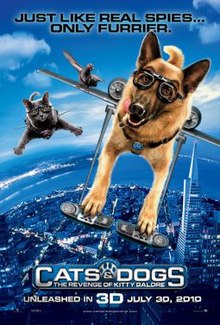
CATS & DOGS: THE REVENGE OF KITTY GALORE is a clever, fun family adventure about a police dog named Diggs who’s recruited by DOG Headquarters to help catch the most wanted feline of all, the outlandishly diabolical Kitty Galore. The movie contains strong moral themes promoting humility, service, working together, and putting aside past animosities.
CATS & DOGS: THE REVENGE OF KITTY GALORE is a fantastically entertaining family movie that tells the exciting tale of cats and dogs working together as a team to protect humans from a maniacal feline foe.
A sequel to the 2001 movie, this follow-up opens with a German Sheppard police dog named Diggs bounding bravely to the scene of a crime alongside his partner/owner, Shane, played by Chris O’Donnell. When Diggs disobeys orders and lunges at the criminal, biting him in the backside, his budding career in law enforcement comes to an end, and the poor pup is put in doggie jail at the police station.
When all hope seems gone, a top agent from DOG Headquarters, Butch, emerges out of the floor and presents Diggs with an irresistible proposition – catch the crazed Kitty Galore before she destroys the bond between humans and dogs forever and seizes world domination.
Diggs is quickly ushered into a world he never knew existed, a subterranean nexus of international canine operations reminiscent of the impressive headquarters of the MEN IN BLACK movies in which strange creatures travel, train, construct, and communicate in their own high-tech, top secret world. It’s here that Diggs is introduced to the rest of the pack, of which he must learn to be a part. The leader is Lou, an all-business, spectacled beagle that barks the orders. Peek, a Chinese Crested, is the agency’s geeky go-to guy for cutting-edge technology, including the Catimatron that helps dogs think like a cat.
Back on the streets, Diggs and his gruff mentor, Butch, voiced by Nick Nolte, meet Seamus, a pigeon with a small grape/big raisin-sized brain and a price on his beak. Kitty Galore has sent assassins after the friendly fowl because he’s had a bird’s-eye view of some of her hush-hush gadgetry.
The fourth member of the crime-fighting menagerie is one Diggs isn’t quite ready to accept: a fearless cat named Catherine who works for MEOWS. Kitty Galore’s vengeful scheme to rule the world, humans and dogs alike, has forced cats and canines to maintain their hatred and be defeated, or join forces and take Kitty down.
Kitty, a former MEOWS agent, has gone rogue. Ostracized by her family when they couldn’t recognizer her after her lush white fur was wiped out in a depilatory vat, the tempestuous cat has become one insane sour puss. While suffering the bizarre costumes and pathetic magic tricks of incompetent carnival magician Chuck the Magnificent, Kitty masterminds her nefarious plot to take over the globe.
The CATS & DOGS sequel is clever, creative, quirky, and highly entertaining, especially in 3D. There is some minor scatological and slapstick humor as well as some violence, but no serious injuries occur. The violence is substantially less than in the first movie, however, and no human or animal character is seriously harmed. One scene in particular may require caution for young children when a group of delirious cats are essentially high on too much catnip.
CATS & DOGS: THE REVENGE OF KITTY GALORE is a fun, witty, exciting family adventure. Diggs, a police dog who’s been caged for disobeying orders, is recruited to embark on a mission to stop a fanatical feline named Kitty Galore. Diggs quickly realizes he’ll have to learn to forgo his own pride and stubbornness to cooperate with others. With the help of a comical ignoramus of a pigeon, the team includes a smart, sassy, fearless cat named Catherine, a gruff mentor named Butch, and tons of far-fetched gadgetry and gizmos. Diggs proves to the others and himself that success can be won when talents are joined with humility and a spirit of service.
The CATS & DOGS sequel contains moral values regarding selflessness, humility and repentance. The cats and dogs must choose to either be friendly and work together, or maintain their animosity and fall apart separately. There is some minor scatological and slapstick humor as well as some violence, but no serious injuries occur. Respect for humans is maintained save for when an avalanche of kitty litter knocks down an elderly woman. One scene about catnip metaphorically implies drug use.
Movies "friends with benefits" seem to be popular at this time. This film is very similar to the last missing strings attached, love and other drugs, but may be the best of the three. There are plenty of laugh at crucial moments. I love Justin Timberlake in comedy. He is always so much fun and that does not disappoint in this film. The rapid-fire witty banter between Dylan and Jamie is very entertaining to watch. Since that kind of movie scenes in the bedroom can not be avoided, but still continues to talk. It is actually fun to watch. However, we can say that the overall story is going and there is not much surprise when Dylan acts as he does at the end. In general, a light and funny rom-com and for those interested.
Friends with benefits is a romantic comedy about two people learning the hard way to get always lead to physical complications. Dylan (Justin Timberlake) and Jamie (Mila Kunis) are performed with the romance and go as they both suffer catastrophic breakdowns. They meet each other when the head of Jamie convinces Dylan Hunter from Los Angeles to New York transplant to work for GQ magazine as art director. They quickly become close friends and decided it would be a good idea to add pure physical sex into the mix, as it will relieve their frustrations, without the problems that come with relationships. It works very well for the two at first, but things get complicated when Jamie decides to appointments and Dylan realizes he's fallen for her.
Anyway, our boy and girl this time around are Justin Timberlake and Mila Kunis who have an undeniable spunky/sexy chemistry.
Timberlake plays Dylan, a website editor from L.A. who is lured to New York by headhunter Jamie (as played by Kunis) to interview for a job to become editor of GQ magazine. Dylan lands the job, the two become friends and before you know it we are off to the races with the "casual sex" plotline and all the predictable twits and turns that follow.
Fortunately for us, though, not only are our leads extremely likeable, they deftly deliver the zippy dialogue scribed by Gluck and co-writers Keith Merryman and David A. Newman.
Also there to inject life into the script at every corner is an exceptional supporting cast of scene stealers. Patricia Clarkson plays a more emotionally damaged version of her maternally spacey role in "Easy A" as Jamie's hippy-drippy mother.
We have a Jenna Elfman sighting as Dylan's sweet and funny older sister who lives back in L.A. with their Alzheimer's riddled father played by the always-brilliant Richard Jenkins. It is a scientific fact that the mere appearance of Jenkins makes any movie 63 percent better.
Then there is Woody Harrelson who would have stolen the movie if he were only given more screen time, as Tommy the boisterous, homosexual, sports editor at GQ. Timberlake deserves a lot of credit for wisely stepping back and letting Harrelson upstage him in their scenes together.
In actuality, it's the restraint of the entire movie that winds up elevating it. While the subject matter is certainly adults-only, "Friends With Benefits" doesn't go for easy laughs with any big gross-out moments or outrageously uncomfortable situations.
Romantic comedies are perennially successful at the box office mainly because of the comfort of familiarity. People will never stop enjoying watching attractive people fall in love and because of that it is very easy for filmmakers to get away with being lazy and unoriginal.
There is nothing lazy at all about "Friends With Benefits" and while it's not exactly blazing any new ground it at least deserves some credit for nudging the genre even just a tiny bit outside of its comfort zone.
Jake Gyllenhaal plays Jamie, a charismatic person who uses his charms to sell pharmaceuticals for Pfizer. Part of this movie, then, is a dig at the lucrative pharmaceutical industry, and the nepotistic relationship between doctors and pharmaceutical sales representatives. But overlying what purports to be an exposé of the moral bankruptcy of the US "medical community" is a personal tale of Jamie's own initial amorality, his lust for wealth, sex, and personal gain, and how he actually matures as a person. In contrast, the industry he works in becomes ever more immature and self-centred, as epitomized (in the movie) by the run-away success of the Pfizer-developed drug, Viagra. Ultimately, sex itself is shown to be one of the drugs that one can be addicted to, often as an escape from one's pain, or a mask for one's own insecurities. And like any drug, it has a transient effect and is not ultimately satisfying. Jamie then meets Maggie, played by Anne Hathaway, and they hit it off immediately because they both seem to want the same thing: casual sex. But Maggie has early-onset Parkinson's disease, and she uses casual liaisons to keep people away from seeing her vulnerability and fear, and also to feel wanted. Her deepest fear is that she will end up alone and abandoned because of the burden that her illness would put on those around her. So, she deeply longs to be loved, and uses sex as a poor substitute for it. But at the same time she is afraid to be loved because that means she would have to be less independent, and actually accept the help of another person, and eventually have to rely on him. This requires trust, of course, and that is possibly what we fear most about love. Fear of trusting another, and so, being vulnerable not only extends to our human relationships, but I think, it may also explain why so many of our contemporaries are afraid to have faith in God, and accept his love. We're so conditioned by society to be independent and self-reliant, or wounded by past experiences, that we might no longer know how to trust another, and be loved, even by God who is Love.
Jamie, on the other hand, does not know how to love. He only knows how to take pleasure, and aim for his own ambitious goals, and he will do anything to achieve his desires. And so, when he tells Maggies he loves her - the first time he'd ever done so in his life - the movie shows him frightened, trembling, and confused. But this realization is the first step towards his becoming human. For he finds himself, and indeed, we all do as persons, in loving others. And so, Jamie, drawn initially by the 'bait' of lust and sexual pleasure, learns to love truly. A turning point comes when Jamie encounters a man whose wife is in the advanced stages of Parkinson's. He recounts with emotion the ravages of the illness, and says that if he had known beforehand, he would not have married his wife. And one wonders if Jamie - who is desperate to find a cure for Maggie's illness for his own sake - would do the understandable thing, and run away from the relationship.
But in the end - after a few more twists to the tale - he doesn't, because he has learnt what it really means to love another, and he sacrifices a much-desired lucrative job promotion to stay with Maggie, and care for her. Hence, in both persons, we see a movement in their characters as they mature as individuals, relinquish fear and selfish pleasures, and learn to grow in the virtue of love itself. What makes this movie compelling, then, is this movement, and the movie allows us to glimpse a part of their pilgrimage of life. And I think, if we're honest, we'll see something of ourselves, and our own moral growth in them. So, seen in a positive light, this movie might well speak to our generation, which is caught up in the transient pleasures of sex and other drugs, and maybe give them pause to reflect on just how much more beautiful, enduring, and powerful love is.
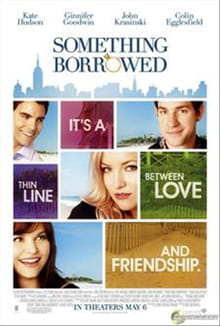
Something Borrowed is classic romantic comedy formula. Young woman is getting married to a dashing young man. Trouble is the girls friend, you know the hopeless romantic friend is in love with the fiance' and has been for years. In fact, she introduced the two lovebirds to each other years ago in college. But as the wedding draws near, sparks are flying where they shouldn't. Will everything work out? That's Something Borrowed.
This stars Kate Hudson as Darcy, the completely self-absorbed fiance'. Darcy is so annoying, that you wonder how anyone can stomach her for an hour, let alone a lifetime. She is a rich, good time party girl that is best friends with Rachel, (Ginnifer Goodwin) since childhood. Trouble is Rachel is in love with Darcy's fiance', Dex (Colin Eggelston). Rachel is the 30 year old boring, lawyer who has none of the vivaciousness as Darcy. But Dex is falling for Rachel. Let's be honest. This has been done to death.
Hudson, could not be worse. She's hard to watch here and grates on your nerves I think even more than the director would want. Overall, Hudson is just not funny anymore. She's limited, and I think has worn out her welcome in the romantic comedy arena. In her slight defense, the writing here is abysmal and not well thought out. They ask Darcy to be irritating and drunk most of the time, and that's limiting for any actor. There is an attempt at the end for Darcy to grow a heart, but it's too late.
Now the silver lining. Ginnifer Goodwin is a star in the making. She has been in a few flicks, including Walk The Line, and He's Just Not That Into You. One great, and one bad respectively. But she is wonderful. Here again, she is lovely, alluring and wonderfully awkward as the lovable loser, love starved young woman. She does this so well. She is so easy to watch on screen, just as she was in He's Just Not That Into You. She was the star there, and here. You can't help but love her here, even as you're trying to choke down this movie, as it goes down sideways.
This formula here is so old. They try to spruce it up. And all they do is make you hate these characters more than like them. As this story stumbles down the aisle, you find you are hoping they all drive off a cliff in some kind of terrible misfortune so we can go home. But that does not happen. But I will tell you this, you will more than likely hate the end of this movie. It tries hard to make you feel something for these backstabbing New Yorkers. And it attempts to be a coming of age flick, and a "things in life change flick." But it fails. Luckily, this movie will get lost in the Thor vacuum that you'll hear loudly this weekend.
J.J. Abrams imitates to flatter with Super 8, an homage to the seminal science fiction films of Steven Spielberg that succumbs to empty nostalgic pandering. As with his Star Trek, Abrams's latest puts a modern spin on classical material, though here reinvention isn't the goal so much as slavish duplication embellished with muscular CG effects.
It's akin to returning to a cinematic womb of Spielbergian father-son issues, suburban households under extraterrestrial strain, and teen romance, friendship, and maturation via out-of-this-world circumstances. The effect of such a modus operandi is initial coziness quickly giving way to disheartening familiarity, with Abrams's own preoccupations (if he had any to begin with) becoming subsumed beneath the root themes, dynamics, and imagery of Close Encounters of the Third Kind and, more fundamental still, E.T. Set in a small Ohio town in 1979, this is a trial-by-fire tale of middle school kids falling in love, strengthening relationships, and reconciling with distant parents that's so clearly modeled after the work of its spiritual godfather (and producer) that, though Abrams's comprehension of his chosen genre tropes is exhaustive and his technical skill is impressive enough to create stirring atmospheric déjà vu, there's little genuine heart to his drama. Instead, in a manner similar to Gus Van Sant's Psycho, it's merely a high-resolution photocopy devoid of its revered predecessors' soul.
After a four-months-prior funereal prologue, Abrams's story finds wannabe creature-feature makeup artist Joe (Joel Courtney) still reeling from the accidental death of his mom, which has left him in the custody of father Jack (Kyle Chandler), a police deputy who—as evidenced by his suggestion that Joe attend baseball camp—neither knows nor cares to understand his son. Joe embarks on summer vacation intent on making a zombie movie with portly friend and budding auteur Charles (Riley Griffiths), whose hectic, sibling-overloaded home blatantly strives to recall the residence of E.T.'s Elliott, whom bike-riding Joe also deliberately resembles.
Filming at an abandoned train station late one night with new cast member and fetching Erika Eleniak look-alike Alice (Elle Fanning), the production crew winds up running for their lives once a speeding locomotive is deliberately derailed—leading to fierce computerized calamity—by the truck of their middle school biology teacher. Soon, the Air Force, led by Nelec (Noah Emmerich), is on the scene and canvassing the town, casting evil military-men shadows while searching for a monster that, as later events reveal, has scared away all local canines and is intent on collecting the area's every electronic and mechanical device, thus causing mysterious power outages.
Abrams keeps this beast off screen for as long as he possibly can, to the point that Super 8—reminiscent of Cloverfield (which he produced)—becomes something of a giant tease. The idea, naturally, is to generate tension from fear of the unknown, and the director does scrape up minor suspense from a few quiet-quieter-silent-LOUD scenes in which only a flurry of gargantuan limbs can be spied. Moreover, this strategy pays early dividends simply because it allows more time to be spent on Joe and his friends, whom Abrams delineates with quick, clear strokes, as well as Joe's growing bond with Alice, whose drunken father Louis (Ron Eldard) was unwittingly responsible for Joe's mom's death, and whom Fanning embodies with a mixture of intimidating radiance and deep humanism. A fantasy vision of female perfection, Fanning's Alice meshes nicely with Joe, a somewhat withdrawn kid nonetheless unashamed to show his dream girl his collection of hand-constructed models. And Super 8 works best when simply lingering in their presence, allowing them to produce a flicker of sincere yearning, fear, excitement and mournful sadness that Abrams's overt attempts at Spielbergian melodrama can't muster, as when the young couple watch a mawkish home movie of Joe and his mom.
Joe and Alice's chaste romance is a vehicle for healing and reconciliation between both kids and fathers, as well as single men alienated by grief and resentment. However, save for one tense exchange between Joe and his dad in which a comment about responsibility resounds with multiple implications, this thread is thinly sketched by the script, which is more interested in checking off items on a Spielberg to-do list than grappling with authentic sentiments. That's also true with regard to the guiding theme about moving forward by letting go of the past, an ironic notion for this backward-looking film, and one that—spoiler alert—extends to the many-limbed creature itself, another government-abused E.T. who's desperate to return home. Even the alien's motivation is told rather than dramatized, leaving the third act in a shambles, brimming with zooms into close-up and vistas of otherworldly chaos that can't compensate for the schematism of the finale's Alice-as-Faye-Wray plotting. All the while, Abrams's aesthetic mode—be it Michael Giacchino's John Williams-ish score or the director's trademark lens flares, which inconsistently heighten emotions (via streaks across eyes)—proves at once proficient and secondhand. Only George A. Romero disciple Charles seems alight with original life, cheerfully reflecting Abrams's (and the film's) youthful cinema love. Yet incapable of transcending its go-nowhere nostalgia, Super 8 ultimately feels stuck in a state of suspended supernatural-sci-fi adolescence.