Jun 25, 2011

Love and Other Drugs

Jake Gyllenhaal plays Jamie, a charismatic person who uses his charms to sell pharmaceuticals for Pfizer. Part of this movie, then, is a dig at the lucrative pharmaceutical industry, and the nepotistic relationship between doctors and pharmaceutical sales representatives. But overlying what purports to be an exposé of the moral bankruptcy of the US "medical community" is a personal tale of Jamie's own initial amorality, his lust for wealth, sex, and personal gain, and how he actually matures as a person. In contrast, the industry he works in becomes ever more immature and self-centred, as epitomized (in the movie) by the run-away success of the Pfizer-developed drug, Viagra. Ultimately, sex itself is shown to be one of the drugs that one can be addicted to, often as an escape from one's pain, or a mask for one's own insecurities. And like any drug, it has a transient effect and is not ultimately satisfying.
Jamie then meets Maggie, played by Anne Hathaway, and they hit it off immediately because they both seem to want the same thing: casual sex. But Maggie has early-onset Parkinson's disease, and she uses casual liaisons to keep people away from seeing her vulnerability and fear, and also to feel wanted. Her deepest fear is that she will end up alone and abandoned because of the burden that her illness would put on those around her. So, she deeply longs to be loved, and uses sex as a poor substitute for it. But at the same time she is afraid to be loved because that means she would have to be less independent, and actually accept the help of another person, and eventually have to rely on him. This requires trust, of course, and that is possibly what we fear most about love. Fear of trusting another, and so, being vulnerable not only extends to our human relationships, but I think, it may also explain why so many of our contemporaries are afraid to have faith in God, and accept his love. We're so conditioned by society to be independent and self-reliant, or wounded by past experiences, that we might no longer know how to trust another, and be loved, even by God who is Love.

Jamie, on the other hand, does not know how to love. He only knows how to take pleasure, and aim for his own ambitious goals, and he will do anything to achieve his desires. And so, when he tells Maggies he loves her - the first time he'd ever done so in his life - the movie shows him frightened, trembling, and confused. But this realization is the first step towards his becoming human. For he finds himself, and indeed, we all do as persons, in loving others. And so, Jamie, drawn initially by the 'bait' of lust and sexual pleasure, learns to love truly. A turning point comes when Jamie encounters a man whose wife is in the advanced stages of Parkinson's. He recounts with emotion the ravages of the illness, and says that if he had known beforehand, he would not have married his wife. And one wonders if Jamie - who is desperate to find a cure for Maggie's illness for his own sake - would do the understandable thing, and run away from the relationship.
But in the end - after a few more twists to the tale - he doesn't, because he has learnt what it really means to love another, and he sacrifices a much-desired lucrative job promotion to stay with Maggie, and care for her. Hence, in both persons, we see a movement in their characters as they mature as individuals, relinquish fear and selfish pleasures, and learn to grow in the virtue of love itself. What makes this movie compelling, then, is this movement, and the movie allows us to glimpse a part of their pilgrimage of life. And I think, if we're honest, we'll see something of ourselves, and our own moral growth in them. So, seen in a positive light, this movie might well speak to our generation, which is caught up in the transient pleasures of sex and other drugs, and maybe give them pause to reflect on just how much more beautiful, enduring, and powerful love is.
Casts:
Jake Gyllenhaal as Jamie Randall
Anne Hathaway as Maggie Murdock
Josh Gad as Josh Randall
Judy Greer as Cindy
Gabriel Macht as Trey Hannigan
Oliver Platt as Bruce Jackson
Hank Azaria as Dr. Knight

Jun 24, 2011

Something Borrowed

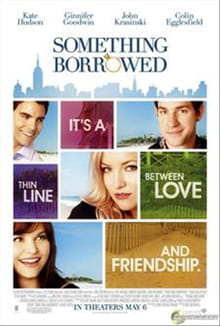
Something Borrowed is classic romantic comedy formula. Young woman is getting married to a dashing young man. Trouble is the girls friend, you know the hopeless romantic friend is in love with the fiance' and has been for years. In fact, she introduced the two lovebirds to each other years ago in college. But as the wedding draws near, sparks are flying where they shouldn't. Will everything work out? That's Something Borrowed.

This stars Kate Hudson as Darcy, the completely self-absorbed fiance'. Darcy is so annoying, that you wonder how anyone can stomach her for an hour, let alone a lifetime. She is a rich, good time party girl that is best friends with Rachel, (Ginnifer Goodwin) since childhood. Trouble is Rachel is in love with Darcy's fiance', Dex (Colin Eggelston). Rachel is the 30 year old boring, lawyer who has none of the vivaciousness as Darcy. But Dex is falling for Rachel. Let's be honest. This has been done to death. 

Hudson, could not be worse. She's hard to watch here and grates on your nerves I think even more than the director would want. Overall, Hudson is just not funny anymore. She's limited, and I think has worn out her welcome in the romantic comedy arena. In her slight defense, the writing here is abysmal and not well thought out. They ask Darcy to be irritating and drunk most of the time, and that's limiting for any actor. There is an attempt at the end for Darcy to grow a heart, but it's too late.

Now the silver lining. Ginnifer Goodwin is a star in the making. She has been in a few flicks, including Walk The Line, and He's Just Not That Into You. One great, and one bad respectively. But she is wonderful. Here again, she is lovely, alluring and wonderfully awkward as the lovable loser, love starved young woman. She does this so well. She is so easy to watch on screen, just as she was in He's Just Not That Into You. She was the star there, and here. You can't help but love her here, even as you're trying to choke down this movie, as it goes down sideways.

This formula here is so old. They try to spruce it up. And all they do is make you hate these characters more than like them. As this story stumbles down the aisle, you find you are hoping they all drive off a cliff in some kind of terrible misfortune so we can go home. But that does not happen. But I will tell you this, you will more than likely hate the end of this movie. It tries hard to make you feel something for these backstabbing New Yorkers. And it attempts to be a coming of age flick, and a "things in life change flick." But it fails. Luckily, this movie will get lost in the Thor vacuum that you'll hear loudly this weekend.


Jun 20, 2011

Super 8

J.J. Abrams imitates to flatter with Super 8, an homage to the seminal science fiction films of Steven Spielberg that succumbs to empty nostalgic pandering. As with his Star Trek, Abrams's latest puts a modern spin on classical material, though here reinvention isn't the goal so much as slavish duplication embellished with muscular CG effects. 

It's akin to returning to a cinematic womb of Spielbergian father-son issues, suburban households under extraterrestrial strain, and teen romance, friendship, and maturation via out-of-this-world circumstances. The effect of such a modus operandi is initial coziness quickly giving way to disheartening familiarity, with Abrams's own preoccupations (if he had any to begin with) becoming subsumed beneath the root themes, dynamics, and imagery of Close Encounters of the Third Kind and, more fundamental still, E.T. Set in a small Ohio town in 1979, this is a trial-by-fire tale of middle school kids falling in love, strengthening relationships, and reconciling with distant parents that's so clearly modeled after the work of its spiritual godfather (and producer) that, though Abrams's comprehension of his chosen genre tropes is exhaustive and his technical skill is impressive enough to create stirring atmospheric déjà vu, there's little genuine heart to his drama. Instead, in a manner similar to Gus Van Sant's Psycho, it's merely a high-resolution photocopy devoid of its revered predecessors' soul.

After a four-months-prior funereal prologue, Abrams's story finds wannabe creature-feature makeup artist Joe (Joel Courtney) still reeling from the accidental death of his mom, which has left him in the custody of father Jack (Kyle Chandler), a police deputy who—as evidenced by his suggestion that Joe attend baseball camp—neither knows nor cares to understand his son. Joe embarks on summer vacation intent on making a zombie movie with portly friend and budding auteur Charles (Riley Griffiths), whose hectic, sibling-overloaded home blatantly strives to recall the residence of E.T.'s Elliott, whom bike-riding Joe also deliberately resembles. 

Filming at an abandoned train station late one night with new cast member and fetching Erika Eleniak look-alike Alice (Elle Fanning), the production crew winds up running for their lives once a speeding locomotive is deliberately derailed—leading to fierce computerized calamity—by the truck of their middle school biology teacher. Soon, the Air Force, led by Nelec (Noah Emmerich), is on the scene and canvassing the town, casting evil military-men shadows while searching for a monster that, as later events reveal, has scared away all local canines and is intent on collecting the area's every electronic and mechanical device, thus causing mysterious power outages.

Abrams keeps this beast off screen for as long as he possibly can, to the point that Super 8—reminiscent of Cloverfield (which he produced)—becomes something of a giant tease. The idea, naturally, is to generate tension from fear of the unknown, and the director does scrape up minor suspense from a few quiet-quieter-silent-LOUD scenes in which only a flurry of gargantuan limbs can be spied. Moreover, this strategy pays early dividends simply because it allows more time to be spent on Joe and his friends, whom Abrams delineates with quick, clear strokes, as well as Joe's growing bond with Alice, whose drunken father Louis (Ron Eldard) was unwittingly responsible for Joe's mom's death, and whom Fanning embodies with a mixture of intimidating radiance and deep humanism. A fantasy vision of female perfection, Fanning's Alice meshes nicely with Joe, a somewhat withdrawn kid nonetheless unashamed to show his dream girl his collection of hand-constructed models. And Super 8 works best when simply lingering in their presence, allowing them to produce a flicker of sincere yearning, fear, excitement and mournful sadness that Abrams's overt attempts at Spielbergian melodrama can't muster, as when the young couple watch a mawkish home movie of Joe and his mom.


Joe and Alice's chaste romance is a vehicle for healing and reconciliation between both kids and fathers, as well as single men alienated by grief and resentment. However, save for one tense exchange between Joe and his dad in which a comment about responsibility resounds with multiple implications, this thread is thinly sketched by the script, which is more interested in checking off items on a Spielberg to-do list than grappling with authentic sentiments. That's also true with regard to the guiding theme about moving forward by letting go of the past, an ironic notion for this backward-looking film, and one that—spoiler alert—extends to the many-limbed creature itself, another government-abused E.T. who's desperate to return home. Even the alien's motivation is told rather than dramatized, leaving the third act in a shambles, brimming with zooms into close-up and vistas of otherworldly chaos that can't compensate for the schematism of the finale's Alice-as-Faye-Wray plotting. All the while, Abrams's aesthetic mode—be it Michael Giacchino's John Williams-ish score or the director's trademark lens flares, which inconsistently heighten emotions (via streaks across eyes)—proves at once proficient and secondhand. Only George A. Romero disciple Charles seems alight with original life, cheerfully reflecting Abrams's (and the film's) youthful cinema love. Yet incapable of transcending its go-nowhere nostalgia, Super 8 ultimately feels stuck in a state of suspended supernatural-sci-fi adolescence.

Apr 23, 2011

127 Hours

127 Hours is the motivational film of the year that proves nature is unforgiving and shows the powerful strength in human determination. Even with the storyline being very basic, it is still captivating enough to not only keep your attention but also make it memorable. James Franco gives it his all with his performance, setting off well deserved Oscar buzz.Aron Ralston (James Franco) is an avid thrill seeker that decides to go hiking into the canyons of Utah. He briefly runs into a couple lost female hikers that are lost. He jokes with them and shows them some amazing swimming areas before departing with them. Little does he know, it is the last time he comes in contact with a person for the next 127 hours.As he is climbing around the canyons, a large rock falls down and pins his arm between canyon walls. He has a very limited amount of supplies for survival including; a water bottle, a little food, rope and a multi-tool. He even had a video camera he brought with, although He immediately begins to try chipping away at the rock to free his arm, but with no success. To make matters worse, he realizes that he told no one where is was going, thus nobody will be looking for him.
It is impossible not to feel empathetic for him. Since he is trapped, he is forced to think about his mistakes he has made in the past. How he is sorry that he did not return his mom’s phone calls and how he wishes he would have brought more liquids to drink. He even creates a faux talk show with himself with the video camera, which is both comical and depressing.
Everything around him is draining; his battery in his camera, the water supply and most importantly his hope of survival. Even the movie poster is shaped like an hour glass as if it were a countdown to his likely death. At one point, he states that his whole life he was drawing him closer and closer to the rock that would eventually trap him in. After 5 days he decides the only way out is for him to cut his own arm off to free him from the large rock.
Undoubtedly, part of what makes 127 Hours so interesting is that it is a true story and how accurate the film is to was actually happened. The real footage of Aron Ralston stuck in the canyon has been restricted to close friends and family members, however, before shooting began, James Franco and Danny Boyle were allowed to watch the footage in order to portray the events in the film accurately.
The most difficult scene to watch in the film was when Ralston has to amputate his own arm. To summon the courage to do that, even in his situation, given the amount of excruciating pain to do so, I feel most people would be unable to do it. The special effects are incredibly realistic and detailed, making it almost hard to watch. Interestingly enough, the scene was done in one take using multiple cameras because they only created one prosthetic arm.
James Franco is simply amazing, working in a very tight space for nearly the entire film by himself. Since there were virtually no supporting roles, he is given the difficult task of carrying on a film alone and does it masterfully. There has not been a role since Tom Hanks in Castaway that done it better. It is a performance that will put him as a serious contender for an Oscar and should win Best Male Lead at the Independent Spirit Awards this year.
Because the film completely straightforward, to keep the audience engaged throughout is a task not easily achieved. Not only was the acting brilliant being is such a confined space with no supporting actors but Danny Boyle gets creative with the camera and special effects to keep it entertaining. 127 Hours is a powerful survival story that ends up being an inspirational statement about choosing to live through willpower.


Grown Ups

After their revered high school basketball coach passes away, Adam Sandler and his four childhood buddies decide to recapture the carefree past by spending some quality time together in an old lakeside house, brimming over with happy memories.

They descend on the desolate countryside resort with their respective families -- hyper-active wives and a bunch of kids bred on playstations and social networks -- and hope to re-connect, like never before. But can the odd, dysfunctional bunch actually survive the weekend under one roof?

Movie Review: Fun while it lasts, Grown Ups is a harmless little picnic film that celebrates friendship, even as it has something important to say. Get back to the outdoors, kids! it exclaims, urging today's tweens and teens to look beyond their playstation screens and FB friends for some real, hard-balled frolic and fun. How about some rock climbing, tree swinging, stone-pelting, roller-coasting, somersaulting, huh?

At least that's what the grown up boys indulge in, with intense merriment and mirth. The re-union for the five friends is filled with moments of boyish fun, which even includes a basketball game, as in the days of yore. Of course, there's a lot of adult teasing and tearing each other apart too, with the wives trying their best to adjust to each other's peculiar habits. Quite a difficult task, specially when you have a high-society diva like Salma Hayek, all set to go to Milan for a fashion show, forced to exchange pleasantries with a homely haus frau, an unambitious mother-to-be and a mother who chooses to breast-feed her four-year-old in public view. The mercury rises further when Rob Schneider's oomphy daughters land up to re-bond with a dad who has a yen for older women, unlike the rest of his friends who like them young and hot.

Savour the Sandler brand of humour with Grown Ups, a film that once again celebrates the spirit of childhood, like most of his comedies.

Apr 11, 2011

Cruel Intentions 2

Teenagers belonging to a seemingly uptight educational institution who connive and conspire against each other to survive in an affluent, quasi-political high school dynamic. That sums up Cruel Intentions

 in a nutshell. If wisecracks and cruel pranks give you the jollies, this teenage flick promises to tickle your funny bone with a vengeance. In an entertainment industry cashing in on slapstick, American Pie inspired themes to lure a younger and admittedly less discerning audience, Cruel Intentions adds an interesting twist to the proverbial teenage angst.

Before I go any further, let me add that this review is on part 2 of Cruel Intentions. Since part 2 was not listed under a separate topic, I took the liberty of using the generic Cruel Intentions review title to post this review. My apologies if I was remiss in my judgement.

Cruel Intentions 2 which is a prequel to the first part has a cast of relatively unknown actors. However the actors handle their parts with aplomb and even though part 2 was not as well received as part 1, primarily due to the lack of high profile celebrity backing, I would definitely not dismiss it as a stereotype washout.

The venue is the Manchester Prep school in Manhattan. A prestigious school for the Upper East Side teenage elite. A backdrop for scandalous relationships, sex and betrayal. Sebastian Valmont is a teenage kid who moves in with his father - a promiscuous but rather daft sort who is married to a wealthy Manhattan socialite. They live in a fashionably large mansion - (a little too Victorian) complete with a butler, a cook, a chauffeur and other domestic help. Sebastian’s biggest stumbling block is his new step-sister Katherine, the most popular girl in Manchester High who stops at absolutely nothing to get her way (including seducing the school’s assistant headmaster and blackmailing him for favors.)

Unwilling to succumb to his step-sister’s powermonger attitude, Sebastian retaliates and a unique sibling rivalry develops between the two. Sebastian takes pleasure in shooting Katherine down every chance he gets. Katherine, in turn, is determined to make Sebastian yield to her dominance in the school. In the meanwhile, Sebastian meets Danielle, the headmaster’s daughter. Danielle is the proverbial goody-two-shoes with a reclusive, coy demeanor that is the complete antithesis of Manchester’s smutty, self-indulgent posse of students. She is also purportedly the school’s ONLY virgin. Sebastian develops an infatuation for her and pursues her relentlessly despite her attempts to evade his more than subtle advances.

Katherine, who is the official student representative at the school also runs secret meetings at an undisclosed location with a like-minded clique of students who determine the fate of anyone in the school. In one of their little meetings, Katherine finds out about Cheri - a very rich but completely naive girl and decides to take her under her wing to turn her into the school’s biggest slut. (Cruel intention there huh). She tries to hook Cheri up with a guy in a nightclub but Cheri gets disgusted when the guy tries to kiss her and throws up all over him. Finally when there is no hope in sight, a little horse-riding lesson does the trick. In the words of Cheri.. no wonder they say women are good with horses.

Built around each of these sub-plots is the movie’s main theme - Cruel Intentions. Sebastian Valmont is looking to survive in this politically driven school environment, but his step-sister seems to thwart his every attempt to belong. At the same time he tries to woo Danielle, who straitjackets his every advance. Finally when Sebastian seems to have gotten his act together and everything seems in place, the plot thickens when Sebastian’s step sister finds out that he forged his transfer documents and transcripts to get admitted into Manchester... and threatens to expose him unless he is willing to - in the words of Katherine - ’’keep it in the family’’ . Sebastian yields - well almost - until his conscience overtakes him and he pulls away and sprints over to Danielle’s determined to tell her the truth about himself. But when he finally meets her, in a rather cruel but delectable turn of events, Sebastian finds out the surprising truth about Danielle.. (which you can find out for yourself if you’re still interested in renting this movie and watching it).

Lights Out

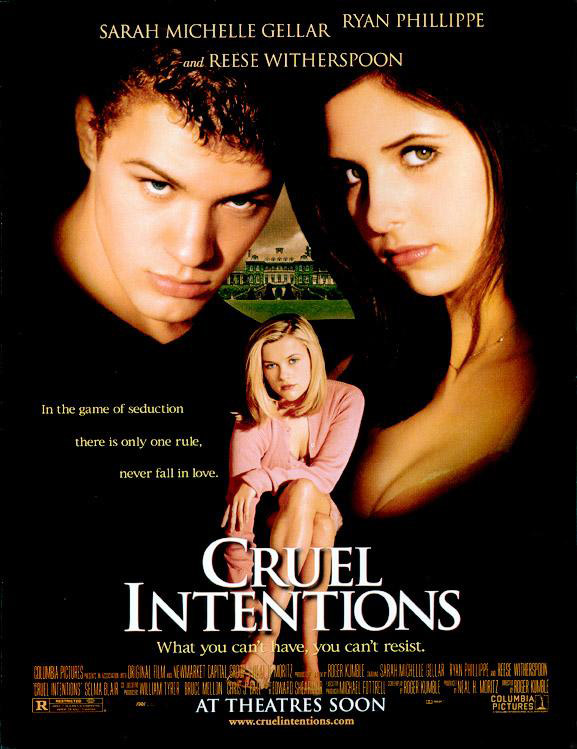
When part 1 came out in 1999, everyone raved about Sarah Michelle Gellar, Ryan Phillipe and Reese Witherspoon’s performances. But even though the story in part 2 is a bit cliched and maybe a little unimaginative (compared to the first part), you will still find yourself getting entertained by the repertoire of wisecracks and sex and drama that this flick has to offer. It might not meet the expectations of those of you who have seen part One..but will certainly entertain those of you who have not.

Cruel Intentions 1

Sebastian Valmont (Ryan Phillippe) and Kathryn Merteuil (Sarah Michelle Gellar) are two devious step-sibling Manhattan socialites on their summer break before their senior year in an exclusive private school, who amuse themselves by playfully flirting with each other and bragging about their various sexual conquests. They are quickly growing bored, however, by the growing air of predictability in the games they play with potential love interests whom they care nothing for. When Kathryn is dumped by one of her boyfriends for the clumsy, childish 15-year-old virgin Cecile Caldwell (Selma Blair, star of "Zoe, Duncan, Jack and Jane"), she is outraged, and asks Sebastian for a favor: seduce Cecile and then spread rumors about her promiscuity, even though she has her eyes set on her black music teacher, Ronald (Sean Patrick Thomas). The stakes grow even higher between Sebastian and Kathryn when she makes a wager with him concerning if he can seduce Annette Hargrove (Reese Witherspoon), a young woman whose father is going to be the new headmaster of their school, and whom has recently written an article in "Seventeen" magazine where she professes her plans to wait until marriage to lose her virginity, before school starts. If he loses, she gets his vintage Porsche. And if he wins, he can enjoy Kathryn in any way he wants. "I'm the one person you can't have," Kathryn tells Sebastian, "and it kills you." Sebastian accepts, but while spend time with Annette, the unthinkable happens: he actually begins to form real, human feelings for her, despite initially only using her.

"Cruel Intentions" is a sleek and stylish comedy-drama that makes no compromises with its title: the two main characters in the film, and even some of the supporting ones, are extremely cruel and emotionally sick people who get their kicks out of using people. Because of this, the film is also certainly not your normal so-called "teenager" movie, and I could easily imagine adults also getting involved in the characters' plight, just like many have with "Dangerous Liasons."

Even if the characters aren't all likable, they are written with a richness you don't often see, and the dialogue between Sebastian and Kathryn is truly fetching and enjoyable, as they don't always say what they mean, or slyly use double entendres to stand for what they are saying. And as played by Phillippe and especially Gellar, the two actor are certainly up to the challenge. Gellar finally has proven with this film that she can very well be a wildly versatile actress that can play sweet with one role and be deceptive and hateful with the next, as she does here. Even if Phillippe isn't always up to her level, he is still well-cast in the role and plays several scenes with a brutal honesty (even if, in the film, he is supposed to be deceiving someone).

As the innocent, beautiful Annette, Witherspoon turns in yet another fine performance to add to her impressive resume (which includes outstanding turns in such films as 1991's "The Man in the Moon," 1996's "Freeway," and 1996's "Fear"), and in one vital dramatic sequence, she is able to transform a potentially cliched scene into something that is thoroughly poignant. Witherspoon also works very well with Phillippe, even if there aren't quite enough scenes between them to believe that they have fallen in love, and they make a quite charismatic pair (perhaps because they are a couple in real life, just recently engaged).

In the fourth and final central role is Blair (in her first starring film), who is a standout as the juvenile Cecile. That Blair is 26-years-old (about two to five years older than the other cast members, even though she plays someone two or three years younger) and is able to believably play a high school freshman only goes to show that she is also very talented, as well as has a firm comic sensibility, since many of her scenes rely on humor. All other actors in the film have relatively small roles who are used as pawns in Sebastian and Kathryn's scheme, including Thomas, as the music teacher; Eric Mabius, as a teenage football player and closeted homosexual; Joshua Jackson, as Sebastian's gay friend; and Christine Baranski as Cecile's aristocratic mother.

Although the story at hand is ultimately a tragic one, and includes a masterfully-done conclusion involving Gellar that rivals the one in "Dangerous Liasons" with Glenn Close, "Cruel Intentions" is also an often very funny comedy, particularly when dealing with small blink-and-you'll-miss details involving the characters, the always-amusing dialogue, and the infantile antics of Cecile. People can criticize "Cruel Intentions" all they want, but when it comes down to it, it is so very similar to 1988's Oscar-nominated "Dangerous Liasons" that it really is hard to nit-pick. The only major difference I can actually detect between the two, except for the obvious (such as the present-day time period and teenage characters), is that the characters in "Cruel Intentions" seem to jump more vibrantly to life. In retrospect, while watching "Dangerous Liasons" not long ago for the first time, despite the brilliant performances by Close, John Malcovich, and Michelle Pfeiffer, all I could really think about was telling the characters, "lighten up already!"